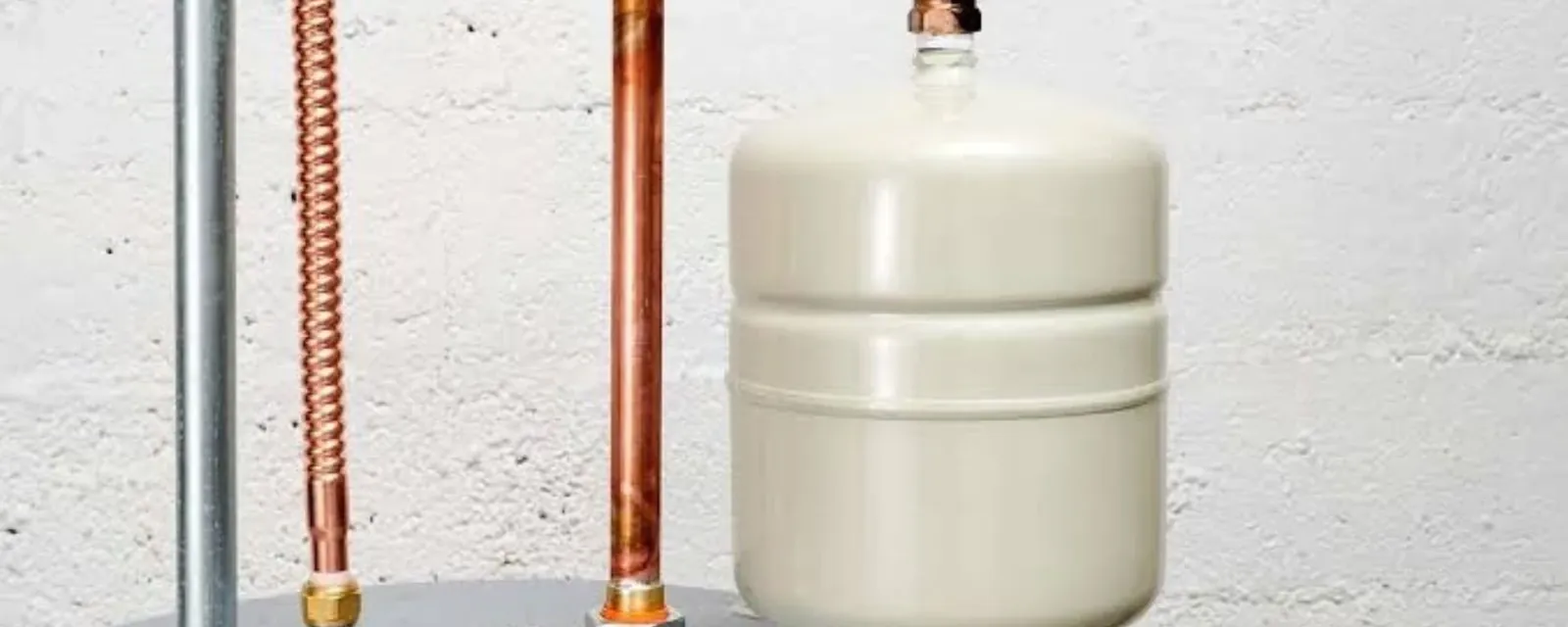
The physics in one paragraph
Water grows in volume when it heats. In an open system the extra volume pushes back into the city main and nobody notices. When a check valve, pressure reducing valve or backflow preventer closes the system, there is nowhere for it to go and pressure in the house plumbing climbs every time the heater runs.
An expansion tank is a small sealed vessel with an air cushion behind a rubber diaphragm. As water expands it moves into the tank and compresses the air. When the heater stops, the air pushes the water back out. Pressure stays in a safe range.
Why a Mundelein house may have a closed system
Many water services now include a pressure reducing valve or a check valve at the meter or at the house entry. Either one can make the system closed. Houses that once ran fine on an open system can become closed after a meter replacement or a valve upgrade, and nobody tells the owner.
That is why a house that never had a problem can suddenly have a dripping relief valve on the heater. The valve is doing its job, and an expansion tank would stop it from having to.
Symptoms that point to thermal expansion
Look for a relief valve that drips after the heater cycles, a faucet that spits when the heater fires, banging pipes after a shower or a toilet that keeps refilling. Any one of those can have other causes, so measure pressure before buying parts.
A gauge threaded onto a hose bib shows static pressure. Watch it as the heater runs. If the number climbs far above where it started, thermal expansion is the cause and a tank is the fix.
How the installation goes
- Test pressure and air charge We read house pressure and confirm the tank's air precharge matches it, adjusting the charge if needed.
- Shut off water and power or gas We close the main, shut off the heater and drain enough to work on the cold line.
- Tee into the cold supply The tank goes on the cold inlet near the heater, supported so its weight does not hang on the pipe.
- Open and check We restore water, purge air, check the fittings for drips and verify the pressure holds as the heater cycles.
Sizing and support
Tanks are sized by heater volume and system pressure. A 40 to 50 gallon heater normally pairs with a small two-gallon class tank, but your pressure and your specific tank change the answer. A tank that is too small fills up and stops protecting the plumbing.
Support matters. A full tank is heavy for its size, and a fitting that carries it alone can fatigue over years. A bracket on the wall or a proper strap keeps strain off the joint.
What a failed tank looks like
Tap the side of the expansion tank. The top half should sound hollow and the bottom half should sound solid. If the whole tank sounds solid, the air side is full of water and the tank no longer protects anything. You can also press the air valve on the top. Water spitting out means the diaphragm has failed.
A failed tank often goes unnoticed for years because nothing seems wrong until the relief valve begins to weep. Checking it once a year is a cheap habit.
Why a relief valve is not the answer
Some owners respond to a dripping relief valve by capping it or swapping it for a new one. Neither fixes the cause. A relief valve is the last safety device on the heater. If it is dripping from thermal expansion, the system is running closer to its limit than it should.
Replacing a valve without finding the pressure problem buys a few weeks. Fixing the pressure problem keeps the valve quiet and protects fittings, faucets, the dishwasher and the toilet fill valves.
Other pressure problems that look similar
High street pressure with no reducing valve, a failing pressure reducing valve, a heater set far too hot and trapped air in the lines can all cause symptoms like those of thermal expansion. A gauge and a short test sort them out.
If the pressure is high even when the heater is idle, the issue is upstream and a tank alone will not solve it. We check the reducing valve first in that case.
Codes and standards
Thermal expansion devices are a recognized part of closed-system water heating under the Illinois Plumbing Code, the state standard (Title 77, Part 890 of the Illinois Administrative Code), and the tank maker's manual sets the air charge.
Local notes for Mundelein
Mundelein's water arrives from Lake Michigan through the Central Lake County Joint Action Water Agency. Pressure at your house depends on your street and elevation, so measure it before you decide. Homes near Diamond Lake and Countryside Lake sit lower than some streets, and that can affect static pressure.
For permit questions on a heater or related work, the Mundelein building office is at 847-949-3283. Water main or street-side questions go to Mundelein Public Works at 847-949-3270.
Cost drivers, in plain terms
| Factor | Why it changes the price |
|---|---|
| Tank size | Larger heaters need larger tanks |
| Access | Tight utility closets add labor |
| Existing valves | Old shutoffs may need replacing at the same visit |
| Heater replacement | Often cheaper to add the tank during a heater swap |
Do it with a heater replacement if you can
If your heater is old and you are already planning a swap, ask for the tank in the same quote. Parts are open and the plumber is already on site. See water heater replacement for what that visit includes.
Nearby homeowners in Hawthorn Woods and Lake Zurich often have private well systems with pressure tanks, which is a different setup. Tell the dispatcher what you have and we plan accordingly.
Questions from Mundelein homeowners
A dripping relief valve, a closed system with a check valve or PRV, and rising pressure when the heater runs are the main signs. A pressure gauge confirms it.
It can be a do-it-yourself job for a confident homeowner, but wrong air precharge or poor support causes trouble. Many people choose a plumber for the pressure test too.
Diaphragm tanks can fail after several years. A tank that feels full of water when you tap it has lost its air cushion and needs replacing.
A small drip is a warning. A steady stream or a hot discharge needs a plumber promptly, and our line is open around the clock.
The Mundelein building office at 847-949-3283 can say what your address needs.
Need a plumber right now?
The line is answered 24/7. Call and a licensed plumber is dispatched.
Call (847) 281-8626