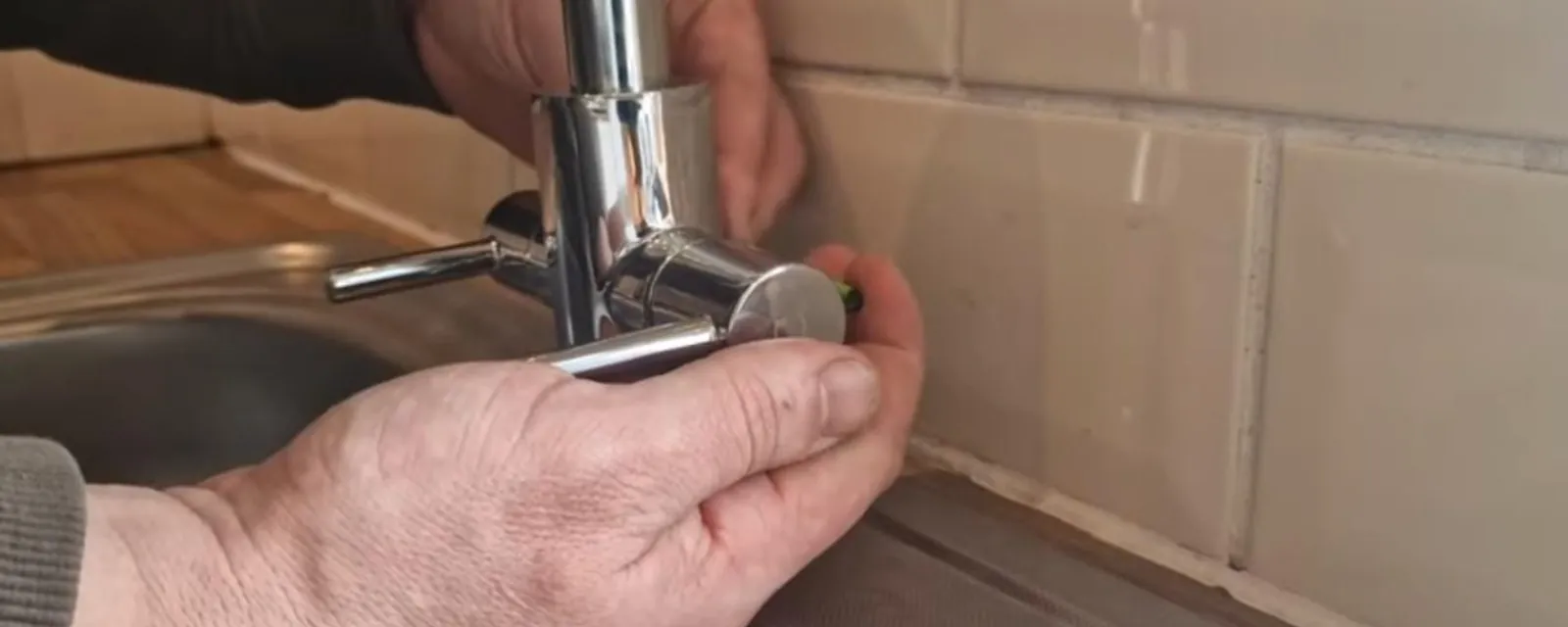
Why faucets leak
Every faucet has a part that stops water, and that part wears. Rubber washers harden, O-rings crack, cartridges wear and valve seats pit. Each drip is a sign the sealing part no longer meets its mating surface cleanly.
Mineral scale makes it worse. Even moderately hard water leaves deposits on the seat and inside the cartridge, and the deposits keep the seal from closing fully.
Faucet types and typical leaks
| Type | Where it leaks | Usual fix |
|---|---|---|
| Compression (two handles) | From the spout | Replace washer and seat |
| Ball (single handle) | Spout or base | Replace seals and springs |
| Cartridge | Spout or handle | Replace the cartridge |
| Ceramic disc | Spout | Replace the disc cylinder |
Identify where the water appears
Water from the spout means an internal seal or seat has failed. Water around the handle means an O-ring or packing nut. Water under the sink may be a supply line, a stop valve or a cracked body. Knowing the location tells us which part we need to bring.
Photograph the faucet and note the brand if you can read it. Cartridge parts are model-specific, and the right match saves a second trip.
A basic repair, step by step
- Shut the supply Close the two valves under the sink, then open the faucet to release pressure.
- Remove the handle Pop off the cap, take out the screw and lift the handle away.
- Pull the cartridge or washer Remove the retaining nut and pull the part. Take it to compare with the replacement.
- Clean the seat Wipe out scale and debris so the new part seats cleanly.
- Reassemble and test Turn the supply on slowly, check for drips at the handle and spout.
When the stop valves are the problem
If the valves under the sink will not close fully, or they leak when you turn them, repair is harder. An old valve can break when forced. A plumber can replace the stop valves as part of the job and leave you with a sink you can isolate in the future.
That small upgrade is worth doing the first time a valve fails, because the next leak will be easier to stop.
When to replace the faucet
A faucet more than fifteen years old, with a pitted finish, a loose body or discontinued parts, is usually better replaced. A new faucet comes with a modern aerator and a long-life cartridge, and a warranty.
If you are replacing anyway, consider swapping the supply lines too. Braided lines cost little and last for years.
Kitchen, bath and outdoor faucets
Kitchen faucets with pull-down sprayers add a hose and a diverter that can leak. Bathroom faucets often use small cartridges that fail quietly. Outdoor hose bibs leak at the packing nut or freeze in winter if the hose stays attached.
In Lake County, remove hoses and shut off exterior spigots before the first hard freeze to avoid a burst inside the wall.
Cost thinking: repair versus new
A cartridge or washer is usually a small cost. A new mid-range faucet costs more in parts, and labor is similar. If the finish is intact and the faucet is under ten years old, repair is the smart choice. If the finish is worn or parts are discontinued, replace.
Either way, ask the plumber to check the shutoff valves while the sink is open, since that is when a failing valve is easiest to replace.
Single-handle versus two-handle faucets
Two-handle faucets usually leak from a washer or seat and are the easiest to repair. Single-handle faucets hide a cartridge or ball assembly that costs a bit more but lasts longer. Know which one you have before you call, and take a photo of the handle and the base.
That photo lets the plumber bring the right part on the first visit.
Codes and standards
Replacement fixtures and supply lines should be rated for potable water and meet the Illinois Plumbing Code, the state standard (Title 77, Part 890 of the Illinois Administrative Code).
Mundelein notes
Mundelein water is moderately hard at about 8 grains per gallon, according to the Central Lake County Joint Action Water Agency. Over the years scale collects in aerators and cartridges. Unscrew the aerator and soak it in vinegar once or twice a year to keep the stream even.
Homes near Diamond Lake and Countryside Lake that rely on older fixtures may also see slow leaks from tired stop valves. Call the Mundelein building office at 847-949-3283 only if you plan to move a supply line or a drain.
Signs a leak is more than a drip
- Water on the cabinet floor even when the faucet is off.
- A handle that wobbles or a base that moves.
- A faucet that drips only after the water heater runs.
- Stains or swelling in the cabinet bottom.
- A rising water bill with no change in use.
Why a small drip deserves attention
A faucet dripping once a second wastes thousands of gallons a year, and the water carries minerals that stain a sink. The drip also hides other issues because it keeps the sink wet. A repair is cheap, and putting it off only adds to the bill.
If the drip started right after another plumbing event, such as a new heater, the cause may be pressure. A gauge on a hose bib tells us in a minute.
What we do on a visit
We identify the faucet type, replace the worn part, test for leaks at every connection and check the valves. If the faucet is beyond saving we show the options. See faucet repair for details, and toilet repair if the bathroom has other drips.
Neighbors in Libertyville and Grayslake reach us on the same 24/7 line.
Questions from Mundelein homeowners
Household pressure can rise when demand falls, pushing a worn seal to leak.
A steady drip can waste thousands of gallons a year.
Yes, if you shut off the supply and match the part exactly.
Scale in the aerator is the usual cause. Clean or replace it.
Mundelein water is moderately hard at about 8 grains per gallon, so scale builds slowly but does build.
Need a plumber right now?
The line is answered 24/7. Call and a licensed plumber is dispatched.
Call (847) 281-8626