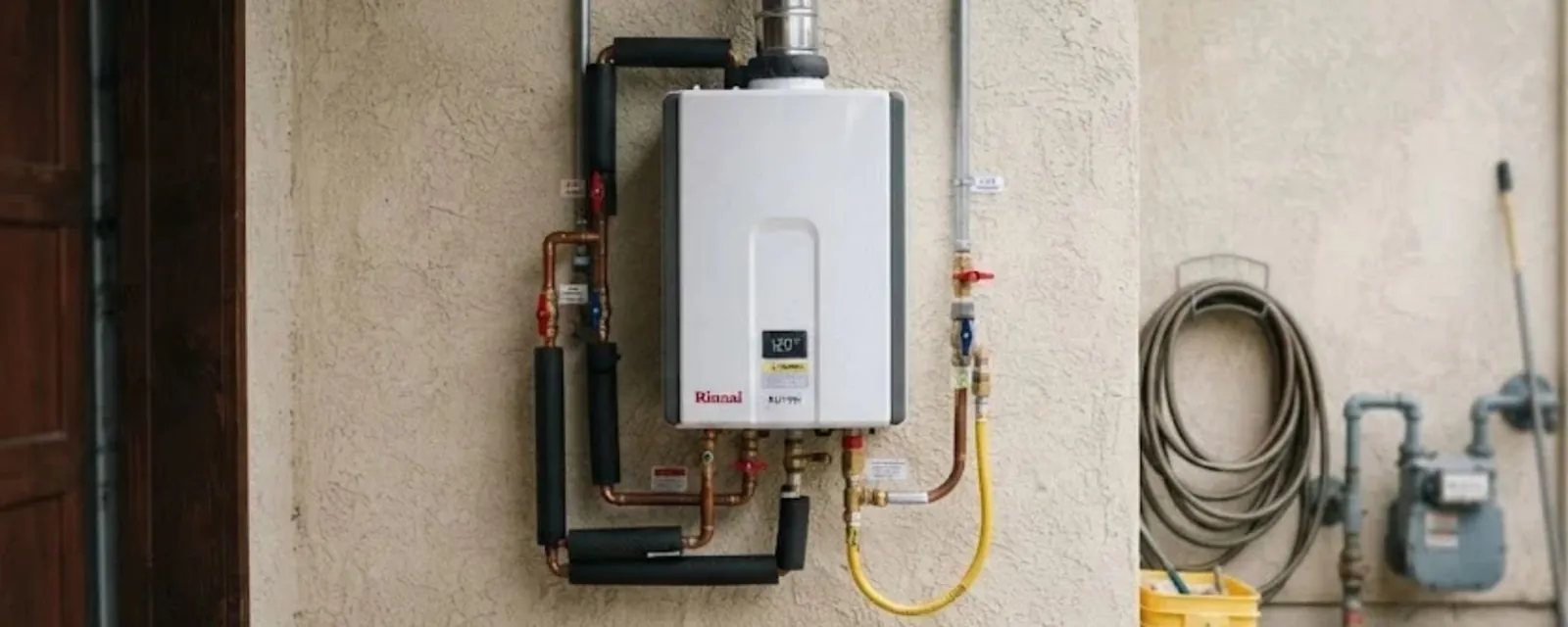
What happens when you open the hot tap
A conventional tank keeps about 40 to 50 gallons hot all day and night. A tankless heater keeps nothing in reserve. When you open a hot tap, a flow sensor sees water moving and tells the control board to fire the burner or energize the elements.
Cold water runs through a heat exchanger while the burner heats it. The unit adjusts its flame to hit the temperature you set, which is why hot water keeps coming as long as the flow stays inside the unit's rated range. Close the tap and the unit shuts down.
Gas or electric, and why it matters in a Lake County house
Gas models usually heat faster and deliver more gallons per minute. They need a gas line large enough to feed a higher burner rating, plus a vent made for the exhaust. Many older Mundelein houses have a half inch gas line sized for a tank heater and a furnace, so the line is the first thing we check.
Electric models avoid venting but draw large amounts of current. A whole-house electric unit can ask for several dedicated breakers, and some older panels cannot supply that without an upgrade. Point-of-use electric units under a single sink are a smaller job.
Flow rate and temperature rise are the two numbers that decide everything
Every tankless unit has a maximum flow in gallons per minute at a given temperature rise. Rise means the gap between incoming water and your target. In a northern Illinois January the incoming water is much colder than in July, so the same unit delivers less hot water in winter.
Add up the fixtures that run together. A shower, a dishwasher and a running kitchen tap can pull more than a small unit can heat. Size for the winter number, not the summer number, or you will notice lukewarm showers in the coldest months.
Tank versus tankless at a glance
| Question | Tank heater | Tankless heater |
|---|---|---|
| Hot water supply | Limited by tank size, then recovery time | Continuous within rated flow |
| Footprint | Floor space for a tank | Wall-mounted, small |
| Venting | Standard flue | Often stainless or PVC, depends on model |
| Maintenance | Anode rod and flush | Descaling flush and filter cleaning |
| Install complexity | Simple swap in most homes | May need gas, vent or electrical upgrades |
The cold water sandwich and other quirks
If you shut a tap off and open it again a few seconds later, you may feel a burst of cold water between two bursts of hot. This happens because the unit shut down and restarted while the pipe held cooled water. Its cause is normal behavior, and not a defect.
Very low flows can fail to trigger the unit at all. A tap opened just a crack may run cold. Recirculation loops and small buffer tanks can smooth this out, and they are worth discussing during the planning visit.
Maintenance you should plan for
Tankless units are not maintenance free. Scale forms inside the heat exchanger and the small water filter at the inlet collects debris. Most makers recommend a descaling flush on a regular schedule, and many units have isolation valves installed for exactly that reason. If your quote has no valves, ask why.
A flush takes a pump, a bucket of descaling solution and an hour or so. Skipping it for years is the main reason tankless units develop error codes and lose efficiency.
Venting and combustion air
Gas tankless units exhaust hotter, wetter gas than an old tank. Condensing models can vent through plastic pipe out a side wall, while non-condensing models need stainless venting. Either way the run, the slope and the clearance from windows and meters must match the manufacturer's sheet.
A vent that is wrong can trip the unit or create a safety hazard, which is why this is not a good place to save money. A site visit before quoting should include a look at where the vent will exit.
Energy use in real homes
A tankless heater avoids the standby loss of keeping a tank hot around the clock. In a house that uses little hot water, that saving is noticeable. In a house that runs hot water all evening, the gap narrows because a tank also loses less heat when it is constantly drawn down.
Treat claims of huge savings with caution. The real gains are continuous supply, a smaller footprint and a longer expected life, not a certain drop in the gas bill.
Codes and standards
Install rules for gas tankless units come from the manufacturer's manual, the Illinois Plumbing Code, the state standard (Title 77, Part 890 of the Illinois Administrative Code) and, as a national benchmark, NFPA 54, the National Fuel Gas Code.
Safety steps for a gas tankless unit
Gas appliances deserve a few ground rules.
- If you smell gas, leave the house and call the gas utility from outside.
- Keep the vent clear of snow, nests and stored items.
- Install carbon monoxide alarms near sleeping areas and test them monthly.
- Never block the combustion air opening near the unit.
- Call a plumber if the unit shows a repeated error code.
Mundelein water and your heat exchanger
Mundelein buys treated Lake Michigan water through the Central Lake County Joint Action Water Agency, which reports hardness of about 8 grains per gallon. That is moderate. Scale still builds inside a narrow heat exchanger over the years, and a flush with a descaling solution on a regular schedule keeps the unit efficient.
Ask the Mundelein building office at 847-949-3283 whether your replacement needs a permit and an inspection. Then bring the manufacturer's venting and gas sizing sheet to the plumber so the plan matches the exact model.
Signs a tankless unit may suit your house
- You have a large family with back-to-back showers and a tank that runs out.
- Your tank is near the end of its life and the floor space is needed.
- Your gas line and venting path can be upgraded without tearing up finished walls.
- You plan to stay in the home long enough to use the longer service life.
- You accept a higher upfront price in exchange for continuous hot water.
Upfront cost and what drives it
A tankless job costs more than a like-for-like tank swap. The unit itself is pricier, and the install often adds a larger gas line, new venting, a condensate drain, isolation valves for flushing and sometimes an electrical or panel change. These extras explain most of the price spread between quotes.
Ask for the quote in writing with each line item. If one bid leaves out venting or gas sizing, it may be the lowest only because it is incomplete. Our tankless water heater team gives the price before work begins.
When to repair and when to replace what you have
If your tank is under ten years old and leaking only at a fitting, a repair may be enough, see water heater repair. If it is rusting at the base or has failed twice, replacement is the better value. That is the moment to compare tank and tankless side by side.
No hot water at night is a real emergency for most families, and we answer the line 24/7. Nearby homeowners in Libertyville and Vernon Hills call the same number.
Questions from Mundelein homeowners
Most gas models need electricity for the control board and fan, so they stop in an outage unless you add battery backup. Ask your plumber about the model you are considering.
Manufacturers often cite a service life near 20 years with regular descaling, which is longer than a typical tank. Real life depends on water quality and maintenance.
Often yes. Call the Mundelein building office at 847-949-3283 with your address and the work planned, and they will tell you what applies.
Sometimes. The deciding points are the vent path, the gas supply and the building rules, so a site visit comes first.
Incoming water is colder in winter, so the unit has to raise the temperature further and may exceed its flow limit. Lowering flow or adding a second unit can help.
Need a plumber right now?
The line is answered 24/7. Call and a licensed plumber is dispatched.
Call (847) 281-8626