Why the wait happens
Hot water has to travel from the heater to the fixture. The pipe is full of cooled water from the last use, and that water has to leave before hot arrives. The longer the pipe and the larger its diameter, the longer the wait and the more water goes down the drain.
A tankless heater does not change that. It makes hot water quickly, but it cannot move the pipe's cold slug closer to your sink.
What a recirculating pump does
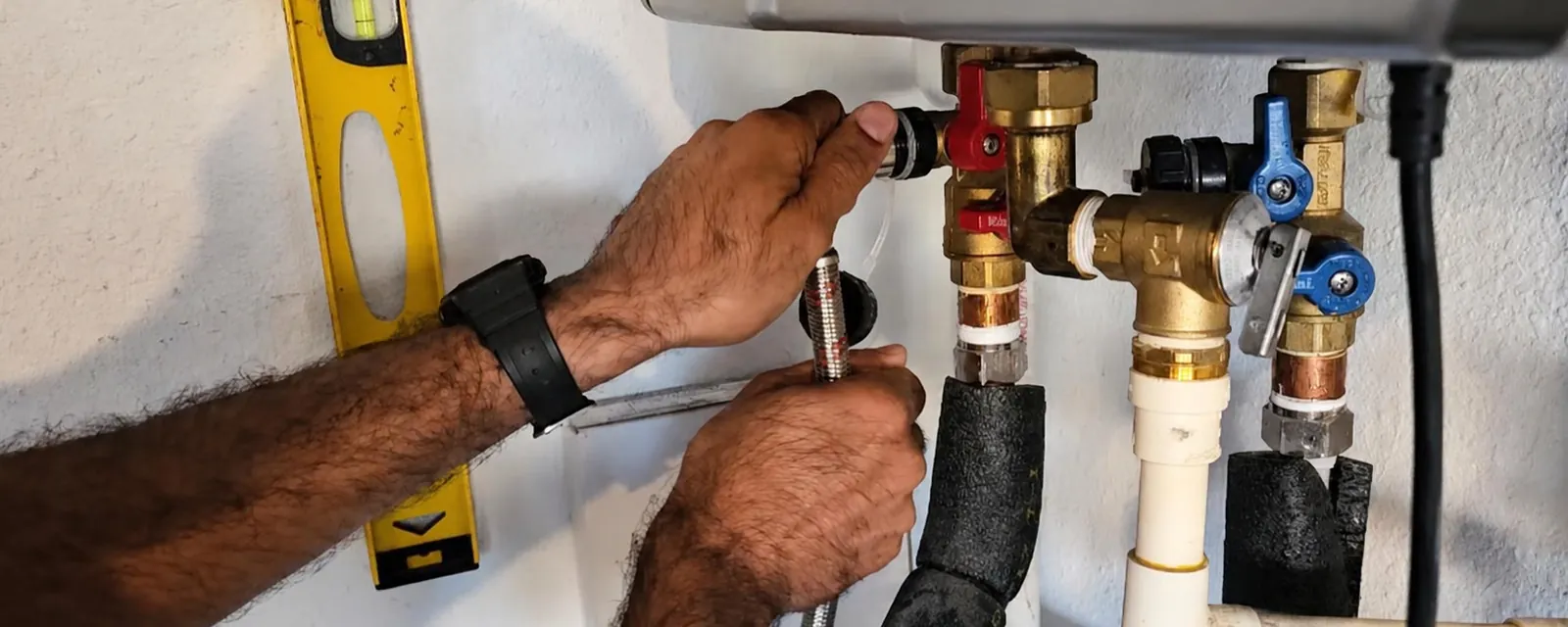
A pump moves water through a loop so hot water stays near the fixtures. In a dedicated return line system, a return pipe brings water back to the heater. In a comfort system without a return, the pump uses the cold line as a temporary return and fixes the problem at a lower install cost.
Either way the pump runs on a timer, a temperature sensor or a button. Running it only when needed matters because a constant loop wastes energy and shortens equipment life.
Three common setups
| Setup | How it works | Typical tradeoff |
|---|---|---|
| Dedicated return line | Separate pipe back to the heater | Best performance, more pipe work |
| Crossover valve under the farthest fixture | Uses the cold line as the return | Simple install, warm cold water for a while |
| Built-in recirculation on the heater | Internal pump and small buffer | Needs compatible model and loop |
Which tankless models support recirculation
Many modern tankless units list a recirculation mode, and some include a small internal buffer. Others expect an external pump. Check the manual or ask the plumber to confirm before buying the pump, because a mismatched pump can trip the heater's flow sensor.
If you are planning a new tankless install, ask for the recirculation plan in the same quote so the pipe and controls are laid out once.
Cost, noise and energy
The pump itself is the smaller expense. Labor, the return line and any electrical outlet near the heater add to the total. A good pump is quiet, but a poorly mounted one can hum through a floor joist.
Energy depends on how often the loop runs and how well the pipe is insulated. Insulating the hot line is cheap and cuts heat loss, so add it during the job.
Retrofit versus new construction
In a new build, a dedicated return line is easy because the walls are open. In an existing house, the plumber must fish a return pipe or use the crossover approach. The retrofit approach costs less and works well on short runs, and the dedicated return performs best on long ones.
Be honest about how often the far fixture is used. A guest bathroom used twice a month does not justify the same loop as a master suite used daily.
Pump failures and what they sound like
Recirculation pumps are small and run often. A failing one may whine, rattle or run hot to the touch. The pump may also seize after sitting unused. Replacement is usually quick if the unit was installed with isolation valves on both sides.
Ask for those valves in the quote. They make the next service visit shorter and cheaper.
Energy and safety checks
Recirculation loops raise the temperature of water that sits in pipes. Set the heater so delivered water is safe at the tap, and consider a thermostatic mixing valve if children live in the house. The pump should shut off when the loop is hot so it does not run for no reason.
These are small details that make a large difference in daily comfort and running cost.
Troubleshooting a pump that does not help
If hot water is still slow, check that the pump is running and that the check valve is oriented the right way. A pump fighting the wrong flow direction does nothing useful. Also confirm the timer matches your schedule, since a pump set for the wrong hours will be off when you need it.
A plumber can test the loop temperature at the far fixture in minutes.
Codes and standards
Recirculation loops should follow the heater maker's manual and the Illinois Plumbing Code, the state standard (Title 77, Part 890 of the Illinois Administrative Code) for pipe, valves and backflow protection.
When to call a plumber about a recirculation loop
Most pump problems are annoying, but a few are safety issues.
- Scalding water at the tap means the heater setting or the mixing valve needs attention.
- A pump that runs hot, smells like burning or trips a breaker should be switched off.
- A leak at the pump or a valve should be stopped with the nearest shutoff.
- Error codes on the tankless unit after a pump is added call for a service visit.
Mundelein notes
Many Mundelein houses in newer subdivisions along Route 60 and Route 83 have a manifold layout with longer branches, and those branches are where waits are longest. Older houses near downtown may have copper trunks that are easier to loop.
A work like this may touch gas, venting or electrical. The Mundelein building office at 847-949-3283 can tell you what permit applies. Mundelein water arrives at about 8 grains per gallon from the Central Lake County Joint Action Water Agency, so scale on a heat exchanger builds slowly but still builds.
Questions to ask before buying
- Does my heater model support a recirculation pump and loop?
- Will you use a timer, a sensor or a push button?
- How will the pump be mounted to avoid noise?
- Is the hot line insulated, and is that in the quote?
- Does the price include an outlet or power connection?
When recirculation is not worth it
A short run to a single bathroom may not need a pump. Moving a fixture closer to the heater or adding a small point-of-use unit can solve the same problem for less. Tell the plumber which fixtures bother you most.
For a new setup, see tankless water heater installation. For a faucet that drips because of pressure changes, faucet repair is the right page. Homes in Libertyville and Vernon Hills get the same advice.
Questions from Mundelein homeowners
It can if it runs all day. A timer or temperature sensor keeps use low.
Not directly. That symptom usually comes from flow limits or the tankless unit's minimum flow.
Often yes, if the model allows it. Confirm with the manufacturer's manual.
Possibly. Call the Mundelein building office at 847-949-3283 with your address.
No. A crossover valve avoids a new pipe, but the cold tap warms for a short time.
Need a plumber right now?
The line is answered 24/7. Call and a licensed plumber is dispatched.
Call (847) 281-8626